
If your website doesn’t generate leads, the issue is not “traffic.” In the majority of instances, it’s the way in which your website was built and the message it conveys within the initial few seconds.
Small-scale business owners typically invest in web development and design services hoping for results, but get a website which doesn’t bring leads.
A highly-performing website doesn’t have to be about trends in design or animations.
It’s all about trust, clarity and guiding visitors towards actions.
In this guide, you’ll discover the specific aspects a small-business website needs to have in order to turn customers into leads. We’ll also look at where the majority of websites make mistakes.
What Features Should a Small Business Website Have to Generate Leads?
A small-sized business website must be designed with a specific goal in mind: It is important for visitors to believe in you and then take another step.
Your website must:
- Simply explain what you are doing in a matter of only a few seconds
- Reduce hesitation through trust signals
- Offer a straightforward, simple action (call, form, booking)
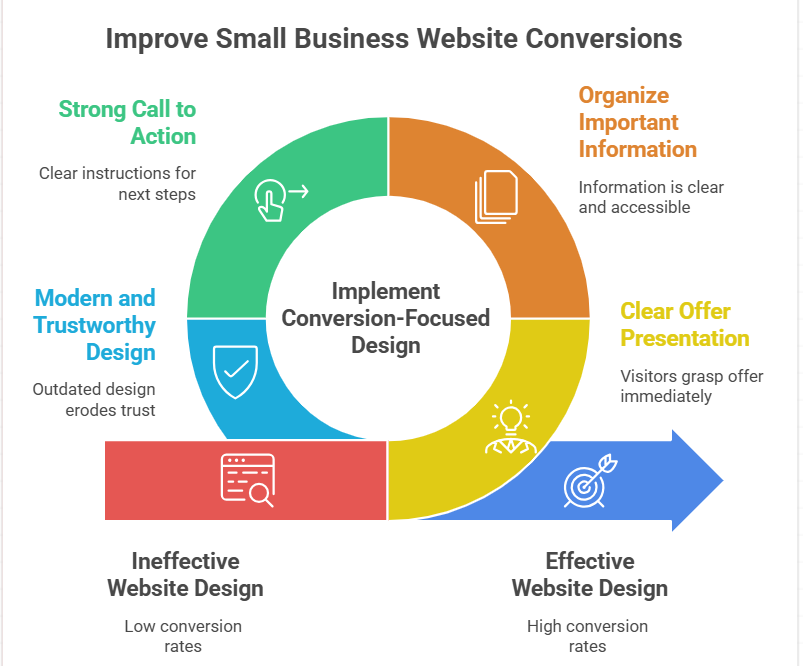
Converting websites do not overwhelm users; they help them navigate.
Why Most Small Business Websites Don’t Convert
In a lot of cases, companies depend on ineffective or poorly designed web development services designed for small-sized businesses that concentrate more on design rather than conversions.
Common reasons are:
- Visitors aren’t sure what the offer is and don’t grasp it immediately
- Information that is important is buried or not clear
- It is not clear that there is a strong call to action.
- The design is outdated and not trustworthy.
If they are disoriented or unsure, they will leave even when they require your assistance.
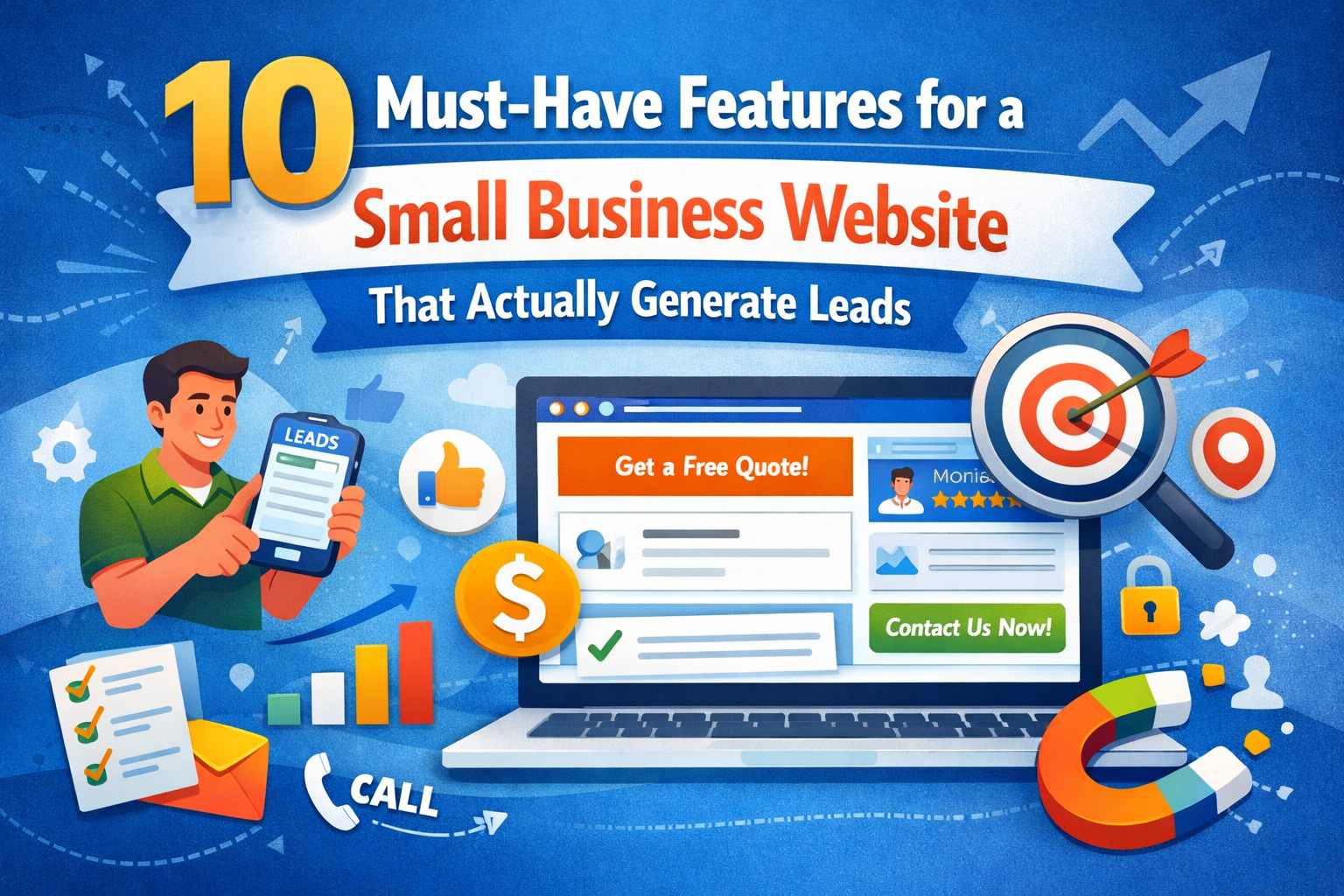
10 Must-Have Features for a High-Converting Small Business Website
1. Clear Messaging Above the Fold
The first section of your website should instantly answer three questions:
- What do you offer?
- Who’s it to be used for?
- What is the next step for a visitor to take?
If this isn’t understood the user won’t continue scrolling.
A clear message eliminates the confusion and sets expectations quickly.
2. Mobile Experience Designed for Real Users
A mobile-friendly website is not enough. Your website should look natural even on small screens.
This includes:
- Large buttons with a tappable function
- Simple scrolling
- Access to options for contact quickly
Because the majority of visitors visit via phones, bad experiences will directly affect the results.
3. Strong and Repeated Call-to-Actions (CTAs)
Visitors don’t convert immediately after their first visit. This is the reason CTAs must be displayed across the entire page, not just on one occasion.
Effective CTAs:
- Use clear action words
- User intent to match
- Appear at natural decision points
In the absence of clear directions, even curious visitors will not act.
Request a free website audit to identify conversion gaps and missed opportunities.
4. Trust Signals That Reduce Doubt
Before reaching out to you, visitors seek reassurance.
Trust signals can help provide the answer to the question:
“Can I trust this business?”
Important elements include:
- Client testimonials
- Ratings or reviews
- Affiliations or certifications
- Real project examples
These elements decrease anxiety and boost confidence.
5. Service Pages That Address Customer Concerns
An error that is common is to create pages for services that simply explain the offerings. This is where web development companies that specialize are able to make a significant distinction. Instead of listing the services they offer, they build pages that help users in getting involved.
Your pages should include:
- Define the problem you are solving
- Then, highlight your method or approach
- Explain what happens when the user has contacted you.
When people can find solutions quickly it is more likely to make a change.
6. Simple and Effective Lead Capture
If you feel that contacting you is difficult people won’t bother.
A successful lead capture system must:
- Make sure that forms are short and easy to understand.
- Do not fill in fields you don’t need.
- Send immediate confirmation
At this point, reducing friction could significantly increase the number of enquiries.
7. Fast Loading Speed
Speed of websites directly influences the user’s behavior.
A slow site can cause:
- Higher bounce rates
- Lower engagement
- Conversions reduced
Speed optimization allows users to remain longer and engage more.
8. Content That Matches User Intent
Visitors have particular questions in mind.
Your content should be addressing:
- Expectations regarding pricing
- Service benefits
- Common issues
- Next steps
If your site answers these questions in a clear manner, visitors do not need to search for another site.
9. Clear Navigation That Guides Users
A well-organized navigation system can help users locate what they want without a lot of confusion.
This is a reference to:
- Eliminating menu items that are not needed
- Highlighting key services
- Contact options are easily accessible
The clarity of navigation enhances the user experience as well as conversion rates.
10. Conversion Tracking and Insights
If you don’t track user actions, you’ll be unable to know what’s happening.
Tracking tools can help you determine:
- Formulary submissions
- Clicks and calls
- The behavior of users on web pages
These data allow you to make improvements to your website over time.
Small Business Website Checklist (Quick Self-Audit)
Use this quick checklist to evaluate your site’s performance:
- Is your message clear within the first few seconds?
- Are CTAs easily visible and easy to comprehend?
- Does your site build trust quickly?
- Are users able to get in touch with you?
- Does your website load quickly across all devices?
If all of the responses include “no,” your website is likely in need of improvement.
Common Website Mistakes That Cost You Customers
Even well-designed websites aren’t always as effective because of simple errors.
They include:
- Too much focus on design and not enough on the usability
- Hiding important contact information
- Pages that are overloaded with unnecessary information
- Ignoring mobile performance
- The user is not being guided towards the right action
Resolving these issues can greatly increase the outcomes.
Improve your results with a professional website optimization strategy.
How to Turn Your Website Into a Lead-Generating System
Enhancing the performance of your website requires an approach that is strategic.
Focus on:
- Clear communication
- User-friendly design
- Trust-building elements
- Continuous testing and updates
A website that can convert is not created at one time. It is developed over time.
Signs Your Small Business Website Needs an Upgrade
Not every website requires the complete overhaul. However, many small-sized websites are at a point that minor fixes aren’t sufficient.
You should think about upgrading your website If:
- There’s no inquiries or leads.
- Visitors leave the site without taking any action
- Your site appears outdated or sluggish on mobile devices.
- It’s challenging to update or expand your business as it expands.
These are clear indications that your website isn’t anymore assisting your business objectives.
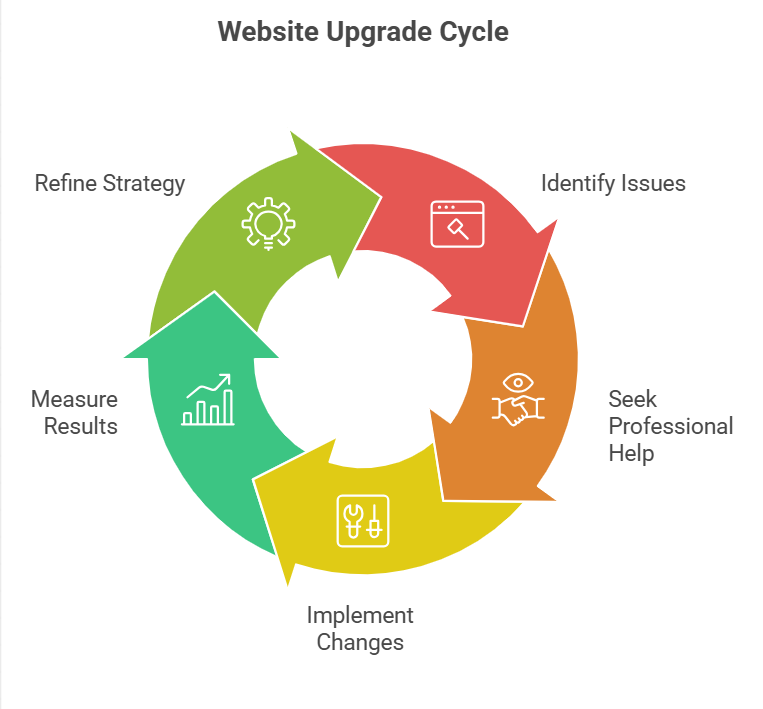
At this point it’s usually not only design, but how the entire structure is constructed, flow of users and an effective conversion strategy.
Working with the right website design and development services can help address these deeper problems. Instead of focusing only on visuals, a structured approach looks at how users interact with your website and where they drop off.
A conversion-focused website design improves results by:
- Your offer will be clear in minutes
- Helping users to take the correct course of action
- Reduce friction in forms and navigation
- Enhancing speed and usability of mobile devices
In addition, SEO-friendly website development makes sure that your website is not only easy to use but also appears in search results, bringing in more targeted traffic over time.
No matter if you require custom website development for small businesses or a complete overhaul of your site the aim will be the same
Create a website that is supportive of the growth of your business, not just its presence.
Create a customized website strategy created to convert visitors into buyers. Contact us now.
FAQs
Q: What are the features the website of a small-sized business includes?
A small-sized business website must have clear messaging, strong CTAs, mobile optimization, fast loading speed, trust signals, and easy lead capture options.
Q: Why is my website not generating leads?
This usually happens due to unclear messaging, lack of trust signals, poor user experience, or weak calls-to-action.
Q: How can I improve my website conversion rate?
Prioritize increasing clarity, reducing friction, incorporating powerful CTAs and optimizing the user experience.
Final Takeaway
A business’s website that is successful is not measured by how it looks, but rather by how efficiently it converts potential customers into leads. By focusing on the most effective aspects and constantly making them better, your website will become an efficient boost to your company.