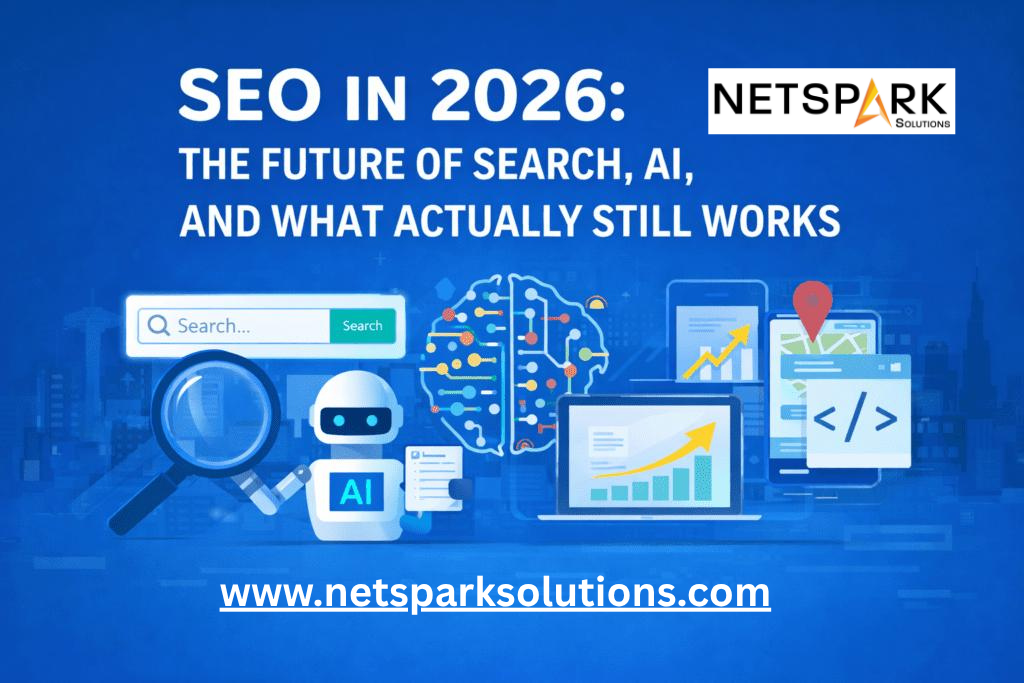

Remember the last time you were searching for anything online and actually clicked through to a site? If you’re honest, it’s happening less and less and less. You got the right answer in the results. Or you queried ChatGPT. Or Perplexity offered you a summary of the answer before you even had time to peruse.
This is not just another SEO trend. AI Overviews now appear in approximately 18% to 21% of Google searches worldwide, while some websites have seen organic click through rates decline by more than 30 percent as AI generated summaries provide instant answers.
At Net Spark Solutions, we talk to business owners and marketing teams every week who are seeing the same issue. Traffic patterns are shifting, leads from organic search are feeling different and the old playbook doesn’t quite explain what is going on. This post is our honest
Why 2026 Is the Real Turning Point for SEO
For the last twenty years or so, search engine optimization meant one thing to most businesses: Rank higher on Google, get more clicks, grow your traffic. It was a game with clear, quantifiable outcomes and a well-understood rule structure. Produce quality content, obtain backlinks, optimize your site and the clicks will follow.
That model is not gone, but it’s not the whole story anymore. Now Google itself answers many queries directly with its AI Overviews function. Bing shows ChatGPT answers. Perplexity pulls in dozens of sources and gives you a crisp, straight answer. Now millions of users start their research adventure in ChatGPT, not in Google at all.
This has a substantial practical consequence. If your content isn’t being picked up, verified, and cited by these AI algorithms, your brand can be utterly invisible to a growing category of potential customers – even if you’re number one on Google. But a competitor with a worse Google ranking but greater off-page credibility and better organized material can show up more than you in AI-generated replies.
This is the change that is behind all of the new optimization approaches that you are beginning to hear about. The good news—and this is really good news—is that the stuff that helps AI systems comprehend your material is also likely to make that information clearer, more helpful, and more valuable to actual human visitors. The two goals are significantly more compatible than they might appear at first sight.
The New Terms Explained: GEO, LLMO, AEO, GXO, and AIO in Plain English
Lately, if you’ve been reading anything about digital marketing, you’ve probably started to notice an onslaught of new acronyms. Some are quite helpful. Some are the same idea, different headwear. Let’s get to the bottom of it and make sense of each one – and begin with what it really means, not what it represents.

- Generative Engine Optimization (GEO)
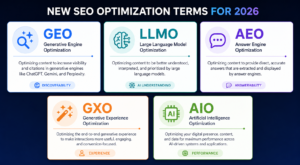
GEO is about applying the ideas of traditional SEO to AI-powered search engines like ChatGPT, Google Gemini and Perplexity. It’s not about being in a catalog of blue links, it’s about being one of the sources these A.I. systems pull from when they generate their responses. This is a crucial and maybe surprising fact: over 85% of the brand mentions that appear in AI-generated responses come from third-party sites and publications, not from the company’s own domain. That implies your off-page presence – reviews, industry mentions, media attention and external references – is hugely important for GEO.
- Large Language Model Optimization (LLMO)
While LLMO is more general, GEO is primarily aimed toward AI search engines. It’s about how huge language models will handle your material throughout the entire ecosystem – chatbots, AI writing helpers, business tools, and any other system running a model like GPT or Claude. The practical application is simple: your content must possess a clear structure, uniform terminology, and semantic organization that AI models can dependably understand. Clear H2 and H3 headings, Schema markup, contextual completeness — these are the building blocks of strong LLMO. - Answer Engine Optimization (AEO)
AEO is all about targeting position zero – the direct answer that comes before any ranking results, whether in a voice search response or chatbot reply. Instead of optimizing for rankings alone, AEO means structuring your content so that it gives clear, immediate answers to specific questions. This is all about FAQ sections, question style headlines and long tail keyword phrases written in natural conversational manner. If someone asks “Chandigarh de chhote business layi GST wala accountant?” your content should be able to answer that. Directly. - Generative Experience Optimization (GXO)
GXO extends the GEO concept to the entire user journey in AI environments, and critically, it incorporates agentic commerce. This is the fast evolving world where AI machines are browsing, comparing, shortlisting and in some cases buying on behalf of customers with little human interaction. GXO is all about making sure your brand and products are shown clearly and credibly in these AI-powered journeys. It’s about API-first design, multimodal content consistency, and AI agents interacting directly with your product and price data. - Artificial Intelligence Optimization (AIO)
All of the aforementioned falls under the umbrella of AIO. Consider this your comprehensive playbook to stay relevant and competitive across every AI-powered platform and touchpoint. It’s a blend of technological integration (APIs and structured data), content strategy (entity mapping and topic authority) and user experience (both human and agent-facing). At Net Spark Solutions, we operate within the AIO framework when we talk about setting out a holistic AI visibility strategy for a customer.
Classic SEO vs. SEO 2026: What Actually Changes
One of the most common fallacies we see is that the new optimization tactics of the AI era are replacing traditional SEO. They don’t. But the fundamentals still matter — possibly more than ever. The range of what you need to think about in conjunction with those fundamentals is changing.
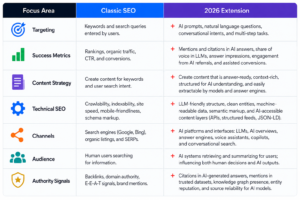
The Five Trends That Are Reshaping Search in 2026
1. Generative search is becoming the standard, not the exception
Google AI Overviews, Bing’s ChatGPT integration, Perplexity — these are no longer in beta or limited rollout. They are mainstream, and they are where a rapidly growing share of searches are landing. Your content needs to work for the way large language models process information: structured clearly, written with genuine topical authority, and free of the keyword-stuffing patterns that used to pass for optimization.
2. People are searching the way they actually talk
Voice search and conversational queries are on the rise across every demographic. Users are no longer typing “Chandigarh dentist” — they are asking “Which dentist in Chandigarh is open on Saturdays and accepts families?” Your content needs to match the natural, specific, sometimes lengthy way people phrase questions when they speak rather than type. This means long-tail keywords written in question format, conversational tone, and direct answers early in your content.
3. Entities and relationships matter more than individual keywords
AI language models understand things — entities — and how those things relate to each other. They do not just match strings of text. This has big implications on your content strategy: you need to build thematic authority around a network of interconnected topics, rather than optimizing one page for one keyword. Use Schema.org markup to clearly define your entities. Link related concepts naturally. Make it obvious to both humans and machines what your brand is, what it does, and what it is associated with.
4. Multimodal content is becoming a search signal
Modern AI models analyze images, videos, and documents — not just text. Every image alt text, every video transcript, every infographic with proper structured markup is a data point that contributes to how AI systems understand and represent your brand. Consistency across all these formats matters: if your image descriptions, your page text, and your video content all reinforce the same core information, that coherence builds confidence in AI systems that your brand is a reliable source.
5. Zero-click visibility is genuinely worth pursuing
Here is a mindset shift that is hard for many businesses at first: a mention of your brand in an AI-generated answer — even without a click, even without a visit — has real value. It builds recognition. It signals authority. It reinforces trust in the minds of people who see your name associated with a reliable answer. Zero-click results are not lost traffic. They are premium brand impressions in exactly the context where your potential customers are actively looking for help. The click very often comes later, when that person is ready to act.
Your 2026 SEO Action Plan: Six Steps That Actually Move the Needle
Here is how we approach AI-era SEO with our clients at Net Spark Solutions. You do not have to do everything at once, and you do not need to overhaul your entire digital presence before you start seeing results. Each of the following steps delivers measurable value on its own — and they compound over time.
1. Understand where your audience is actually searching
Before you change anything on your website, spend time understanding where your specific customers are going for information. Are they primarily using Google? Are they asking ChatGPT for product comparisons? Do they use voice search frequently? The answer varies by industry and audience, and it determines which channels deserve your attention first and which content formats will be most effective for you.
2. Build your content strategy around topics and entities, not just keywords
Create clusters of content that cover your subject area from multiple angles. If you run a financial consultancy, that means interlinked content about tax planning, business structure, investment basics, compliance requirements, and common mistakes — not just one page for each service. Each piece of content should link naturally to related pieces, and each cluster should use consistent terminology throughout. Schema.org markup on key pages signals to AI systems how all of this fits together.
3. Make your important content visible without JavaScript
Many AI crawlers cannot execute JavaScript, which means any content loaded dynamically on your pages — through React, Vue, or similar frameworks — may be completely invisible to the bots that index your site for AI systems. Test this yourself right now: open your most important pages in a browser and disable JavaScript in the settings. Is your key content still there? If it disappears, server-side rendering for those critical pages belongs on your technical roadmap as a priority.
4. Apply structured data consistently and correctly
Schema.org markup for FAQs, articles, local businesses, products, and reviews gives search engines and AI systems the context they need to correctly categorize and use your content. Pair this with clean, semantic HTML — proper heading hierarchies, meaningful element tags like article, section, nav, and main rather than an endless chain of div elements — and you create a site that both human visitors and AI systems can navigate with confidence.
5. Invest seriously in off-page authority and third-party mentions
Because 85% of brand mentions in AI responses come from third-party sources, your PR strategy, your backlink profile, your review presence, and your industry media coverage have taken on new strategic importance. A mention in a respected trade publication or a well-written review on a trusted platform often carries more weight in AI systems than a page on your own website. This isn’t about gaming the system — it’s about building the kind of real external credibility that people and AI both recognize as real.
6. Make your AI presence a business metric you track
Standard analytics tools don’t track zero-click AI impressions or where your brand is showing up in AI answers. Make it a habit to check your brand’s presence in AI tools like ChatGPT, Perplexity, and Google Gemini for questions that matter to your business. Are you mentioned at all? Is the information accurate and current? Where are your competitors appearing instead? This ongoing monitoring is the new equivalent of checking your Google Analytics weekly — and it is just as important.
If You Sell Products Online: Data Quality Is Your 2026 Competitive Advantage
For e-commerce businesses specifically, the rise of AI-powered shopping introduces an additional layer of strategy that is worth understanding separately. Platforms like ChatGPT are beginning to surface product recommendations directly within conversations, and the products that get recommended are not necessarily the ones with the highest ad spend or even the strongest SEO. They are the ones with the cleanest, most complete, and most consistent data.
That means complete and accurate product titles and descriptions, real-time pricing and availability data, trust signals like return rates and quality scores, and contextual information such as FAQ sections for individual products, use case explanations, and clear relationships between related items (accessories, alternatives, bundles). An AI system can only confidently recommend what it fully understands. The quality and consistency of your product data is quickly becoming one of the most direct competitive levers available to online retailers.
Final Thoughts
As we look to 2026, SEO is no longer just about ranking higher on Google. Companies must optimize for AI generated answers, conversational search, voice assistants and new AI agents. Through the use of GEO, LLMO, AEO, GXO and AIO strategies brands can improve their online visibility, build authority and stay competitive in an increasingly AI powered digital world. The future belongs to companies that create content for humans and machines and the best time to start is now.
Contact Net Spark Solutions at [email protected] to learn how AI focused SEO strategies can help your business stay visible, relevant, and competitive in 2026 and beyond.