
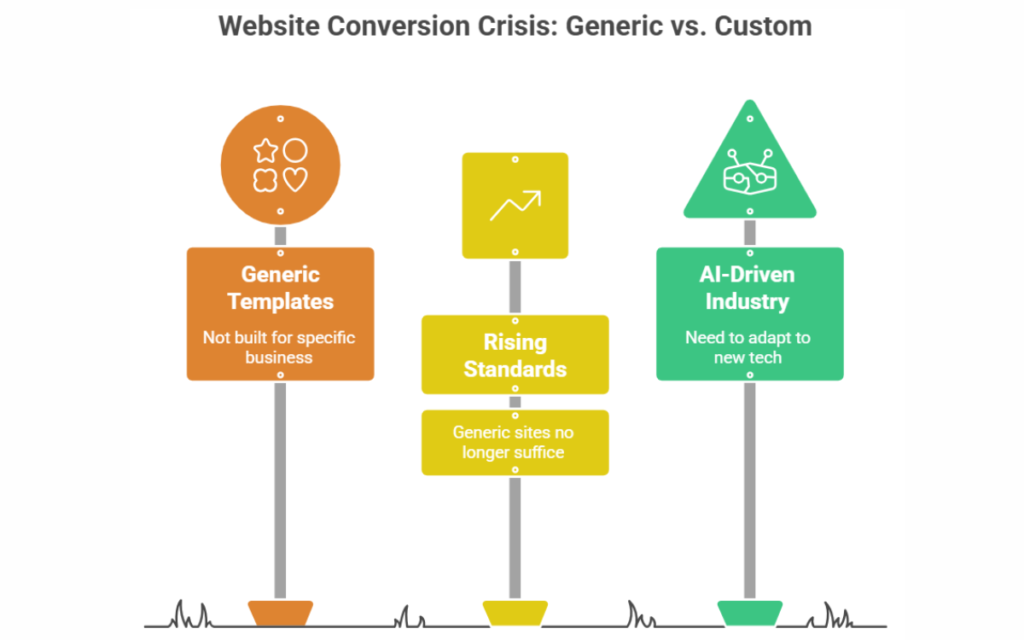
Most businesses don’t lose customers because their product falls short. They lose them because their website is. In 2026, your website isn’t a supporting asset — it’s the decision-maker. And the gap between a site that converts and one that doesn’t come down to one thing: whether it was built for your business, or built for everyone. In 2026, the bar for what makes a “good” website has risen sharply, and the gap between a generic template site and a thoughtfully custom-built one has never been wider.
This blog post cuts through the noise to give you an honest, practical look at custom website development today: what it actually involves, when it makes sense for your business, and what you need to watch for in a rapidly AI-driven industry.
The Landscape Has Shifted — Dramatically
Let’s start with context, because a lot has changed.
Not long ago, getting a custom website meant hiring a custom website developer to hand-code every element from scratch. That’s still an option, but it’s no longer the whole picture. Today, over 80% of software companies have integrated AI tools into their development processes, and developers using AI assistants report completing work 30–60% faster than they did just a few years ago.
This doesn’t mean custom development is cheaper or easier — it means skilled full-stack web developers can now build more in less time. The craft hasn’t gone away; it’s evolved. The best custom website developers today aren’t just coders — they’re architects, strategists, and AI orchestrators who know how to combine human judgment with powerful tools to build something genuinely tailored to your business.
If a full-service web agency in 2026 isn’t incorporating modern tooling into their workflow, that’s worth questioning.
What Is Custom Web Development — Really?
Custom web development means building a website specifically around your business: your brand, your goals, your users, and your growth plans. Nothing is borrowed from a generic template. Every design decision, every feature, every interaction is deliberate.
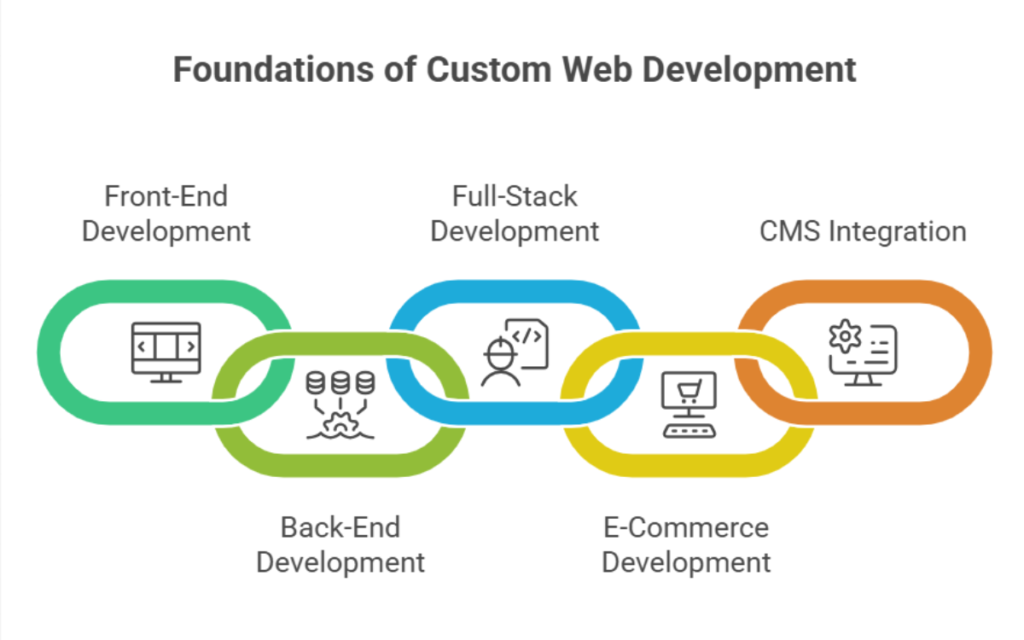
Here’s a practical breakdown of what that includes:
-
Front-End Development
Everything a visitor sees and touches — layouts, buttons, animations, navigation. In 2026, this goes beyond “looking good on mobile.” It means building for performance (sites loading in under 2.5 seconds see an average 15% increase in conversions), accessibility, and adaptive experiences that respond to who’s visiting.
-
Back-End Development
The engine under the hood — databases, server logic, APIs. This is what lets your site handle real business operations: processing orders, storing user data, connecting with your CRM, triggering automations.
-
Full-Stack Development
A combination of both front-end and back-end development. A full-stack developer or team can take ownership of the entire product, which tends to result in more cohesive, better-integrated websites.
-
E-Commerce Development
This requires special attention due to higher stakes. A poorly built store loses sales. A well-built one — with fast checkout, smart product recommendations, and reliable payment integration — earns trust and drives repeat business.
-
CMS Integration
Provides control over your website content. Whether it’s WordPress, a headless CMS, or a custom admin panel, a good CMS means your team can update content, publish posts, and manage pages without touching a line of code.
The Question Everyone Should Ask: Do I Actually Need Custom?
Honestly? Not always. And any agency that tells you otherwise without understanding your business first isn’t being straight with you.
Here’s a simple way to think about it:
A template or website builder probably works fine if:
- You’re a local service business (plumber, salon, freelancer) who mainly needs contact info and a few photos online
- You’re validating a business idea and need something live within days
- Your budget is under a threshold where custom development makes financial sense
Custom development starts making clear sense when:
- Your website needs to do something — handle bookings, process payments, serve personalized content, integrate with your backend systems
- You’re in a competitive market where differentiation matters and a template-looking site hurts your brand
- You’re planning to scale, and the limitations of a cookie-cutter platform will eventually force a full rebuild anyway
- You need performance and SEO baked in from the start, not bolted on later
The real cost of a cheap template often shows up 18 months later — in a rebuild you didn’t budget for.
What Makes a Custom Website Worth the Investment in 2026
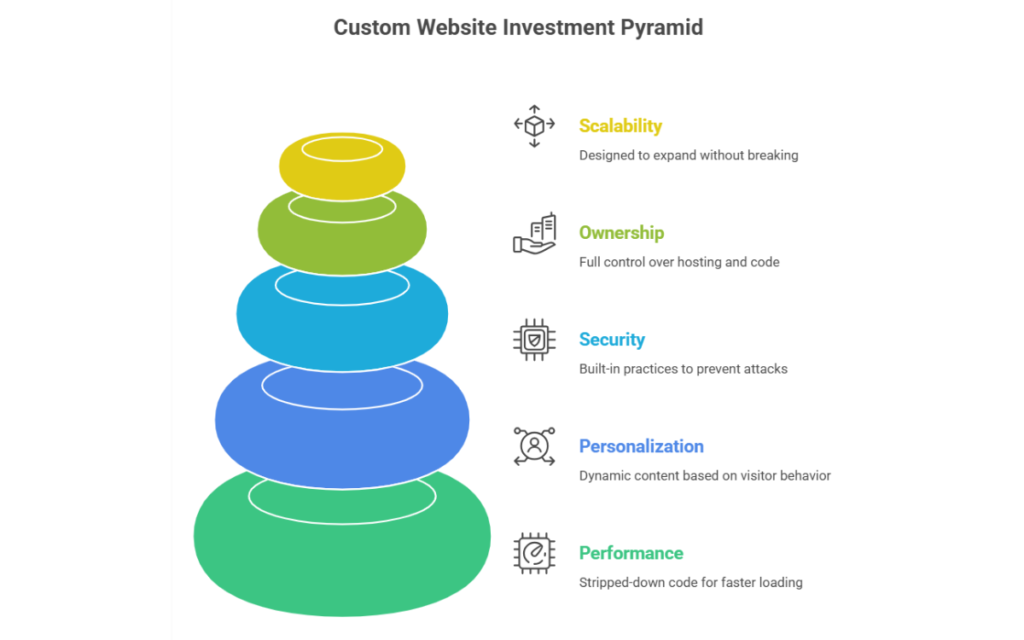
1. Performance Is Now a Business Metric
Speed has always mattered, but in 2026 it’s quantifiable and consequential. Google’s Core Web Vitals directly influence your search rankings. Users abandon pages that take more than 3 seconds to load. A custom-built site — stripped of unnecessary plugins, bloated theme files, and generic code — simply performs better than most templates out of the box.
2. AI-Powered Personalization Is Becoming a Standard Expectation
A growing number of businesses are using their websites to deliver personalized experiences: showing different content based on where a visitor came from, what they’ve looked at before, or what stage of the buying journey they’re in. This kind of dynamic personalization isn’t possible with a standard template. It requires a custom build with the right integrations in place.
3. Security Is Built In, Not Added On
Templates and popular plugins are high-value targets for hackers precisely because they’re widely used. A custom-built site can follow security best practices from the ground up — cleaner code, fewer attack surfaces, and no dependency on third-party plugins you don’t control.
4. You Own It Completely
With most template platforms, you’re renting. Change the platform’s pricing, policies, or features, and your site changes too. A custom website is an asset you own outright — you control the hosting, the code, and the roadmap.
5. It Grows With You
Good custom development is built for scale. Adding a new product line, launching a new market, integrating a new tool — these things shouldn’t require starting over. A well-architected custom site is designed to expand without breaking.
What to Look for Before You Start
Before you talk to any developer or agency, get clear on these:
-
Your primary goal
Is this website meant to generate leads, sell products, build brand credibility, or serve existing customers? The goal drives every decision that follows.
-
Your users
Who are they, and what do they need to do on your site? User experience starts with understanding real people, not assumptions.
-
Your existing systems
What tools do you already use — a CRM, an inventory system, an email platform? A custom site should talk to these, not exist in isolation.
-
Your timeline and budget
Be realistic. A well-built custom website takes time. Rushed development creates technical debt that costs more to fix later. Build in room for iteration.
-
Long-term maintenance
A website isn’t a one-time project. Who will update it, host it, and keep it secure after launch? Make sure this is part of the conversation before you sign anything.
Platforms and Technologies That Matter in 2026
The right technology stack depends on what you’re building. Here’s an honest snapshot:
-
WordPress
It remains the world’s most widely used CMS — powering over 43% of all websites globally. It’s genuinely flexible and has embraced modern development practices. The right developer can build something exceptional on it; the wrong one can build something terrible. The platform isn’t the differentiator — the developer is.
-
Shopify and WooCommerce
This remain strong choices for e-commerce, each with distinct trade-offs. Shopify is fast to launch and easy to manage; WooCommerce offers more customization for businesses already in the WordPress ecosystem.
-
Headless CMS architectures
This (using platforms like Contentful, Sanity, or Strapi with a custom front end) are gaining traction for businesses that need performance, flexibility, and multi-channel content delivery — publishing content to a website, a mobile app, and digital displays from a single source.
-
Laravel
It continues to be a strong choice for building custom web applications with complex business logic — think booking systems, portals, dashboards, or platforms with unique workflows that no off-the-shelf tool handles well.
The honest truth: the best stack is the one that fits your use case, your team’s expertise, and your long-term plans — not the one that’s trending on a blog post.
A Note on AI and What It Means for You
You’ll hear a lot of noise about AI “replacing” web developers. The reality is more nuanced — and more useful to understand.
AI tools are making skilled developers faster and more capable. What once took a team weeks can now be scoped and built in days. That’s good for businesses: it means more iteration, faster delivery, and potentially better value for your investment. At Net Spark Solutions, we create websites that are designed to deliver real business results.
What AI hasn’t replaced — and won’t anytime soon — is judgment. Knowing what to build, why it matters to your users, and how to make it serve your business goals: that still requires experienced humans. The best custom web partners in 2026 are using AI as a force multiplier, not a shortcut.
When evaluating agencies or developers, don’t be afraid to ask directly: how are you using AI tools in your workflow, and how does that benefit the project? If they can’t answer that clearly, keep looking.
Frequently Asked Questions (FAQs)
-
What Technologies Are Used in Modern Web Development?
Modern web development uses technologies like React, Node.js, Laravel, and CMS platforms such as WordPress and Shopify to create fast, responsive, and secure websites.
-
Why Should You Choose Custom Web Development Over Templates?
Custom websites offer better flexibility, unique design, and advanced functionality. Unlike templates, they are tailored to your business goals and provide long-term benefits.
-
Is Custom Web Development Important for SEO?
Yes, custom-built websites are SEO-friendly because they have clean code, faster loading speed, and mobile responsiveness, which help improve search engine rankings.
-
How Long Does It Take to Build a Custom Website?
The development time depends on the project complexity. A basic website may take a few weeks, while a complex custom website can take several months.
-
How Do Custom Web Development Costs Compare to Off-the-Shelf Solutions?
Custom web development usually costs more upfront compared to off-the-shelf or template-based solutions. However, it offers better flexibility, scalability, and long-term value, making it a cost-effective choice for growing businesses.
Final Thought
A custom website is an investment — in your brand, your users, and your long-term business growth. Done right, it pays for itself many times over. Done poorly, it becomes an expensive obstacle you’ll be replacing in two years.
In 2026, the good news is that the tools and talent available to build genuinely excellent custom websites are better than ever. The challenge is knowing what to ask for, who to trust, and what questions to ask before the work begins.
That’s exactly what this guide is for. If you have more questions about where to start, we’re happy to talk.
Net Spark Solutions builds custom websites designed around your business goals — not templates, not shortcuts. Reach us at [email protected].